
TEA Releases Bluebonnet Learning First-Year Results
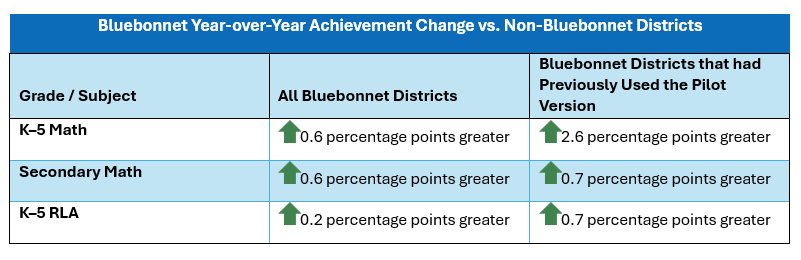
Districts using Bluebonnet Learning saw stronger average year-over-year achievement changes in reading and math
AUSTIN, Texas – September 30, 2026 - The Texas Education Agency (TEA) today released first-year usage and outcomes data for Bluebonnet Learning. Offered as an option by TEA and approved by the State Board of Education (SBOE), Bluebonnet Learning is a set of high-quality instructional materials designed for Texas classrooms and aligned with Texas state standards, the Texas Essential Knowledge and Skills (TEKS).
During the 2025-2026 school year, 619 districts opted to implement at least one of the three Bluebonnet Learning programs district-wide. In the first year of availability, districts using Bluebonnet Learning on average saw better year-over-year achievement change than non-Bluebonnet districts. Specifically, the percentage of students who met grade level in the relevant grades of Bluebonnet adoption in reading or math for Spring 2026 STAAR assessments versus Spring 2025 STAAR assessments was greater, compared to the same year-over-year change in non-Bluebonnet districts. 72 districts using at least one Bluebonnet Learning program earned an "A" rating in 2025-2026, including 26 that had a rating below an "A" the previous year.
Implementing high-quality instructional materials is a significant undertaking and requires teachers and school leaders to adjust to new pacing, practices, and rigor. This makes the improvements seen in the first year an encouraging sign of early progress and is a testament to the work of Texas educators.
In addition to improving student learning, Bluebonnet Learning saves taxpayers money. Print costs for Bluebonnet are lower than other instructional materials. For example, over a four-year period, Bluebonnet Learning Grade 2 math is $1,350.88 less expensive per classroom than the next comparable available material approved by the SBOE, and Grade 2 RLA is $498.48 less expensive. Printable PDFs can be downloaded online for free and printed by anyone.
Students in Bluebonnet reading classrooms learn phonics, practice handwriting and refine their grammar, all while reading great stories like Paul Bunyan, classic novels like Treasure Island, and the writings of Dr. Martin Luther King, Jr. Students in Bluebonnet math classrooms become automatic with their times tables, learn fractions, and develop a mastery of algebra.
Bluebonnet Learning is not just one material but instead is offered as 39 unique sets of elementary and secondary instructional materials to support teachers. This includes teacher guides, student activity books, novels, quizzes, worksheets, image cards, and more. In total, there are 2,300 components.
Unlike other instructional materials used by schools, Bluebonnet Learning is designed for total transparency. Every unit includes a take-home letter so that parents know exactly what their children are learning, and all Bluebonnet content is available to view at bluebonnet.tea.texas.gov.
Because the lessons in Bluebonnet Learning are owned by the State of Texas, TEA works closely with Texas teachers who use Bluebonnet materials in their classrooms to make improvements based on teacher feedback. In this way, the benefits that one district experiences with Bluebonnet can be more easily spread to others across the state as district adoption of Bluebonnet Learning continues to grow. Similarly, TEA is working with districts that saw gains and districts still working toward them to identify what's making the biggest difference and help every school build on it.
“Bluebonnet Learning is an important resource to help our schools focus on the fundamentals of literacy and numeracy. With insights from year one, we will continue our investments in rigorous curriculum to make Texas number one in public education,” said Texas Education Commissioner Mike Morath.
For more information on Bluebonnet Learning, visit tea.texas.gov/bluebonnet.
###